The useful starting point for curly hair is not a trend photo but the version of your hair that shows up after it dries. A cut can look neat when wet, then spring upward, widen at the sides, or leave one area looking unexpectedly thin. The best hairstyles for curly hair make room for that change instead of treating it as a flaw to hide.
Read shrinkage and density before choosing a shape
Shrinkage is the distance between a stretched curl and its dry resting length. It is not consistent across one head: the nape may hang lower than the crown, while the front recoils first. Before booking a cut, wash and dry your hair in its usual routine, then take front, side, and back photos in daylight. Those photos show where the outline actually lands, which is more useful than judging it in a steamy mirror.
Choose haircuts for curly hair that move with the curl pattern
Density changes the decision. Dense curls can carry a rounded outline and still feel full after internal weight is removed. Fine or low-density curls often need a cleaner perimeter so the ends do not turn see-through. Notice whether your scalp is visible only at a parting or across the crown, and whether the lower layers collapse under the upper ones. These details help separate a request for lighter hair from a request for a different overall shape.
Wash-day choices decide the final outline
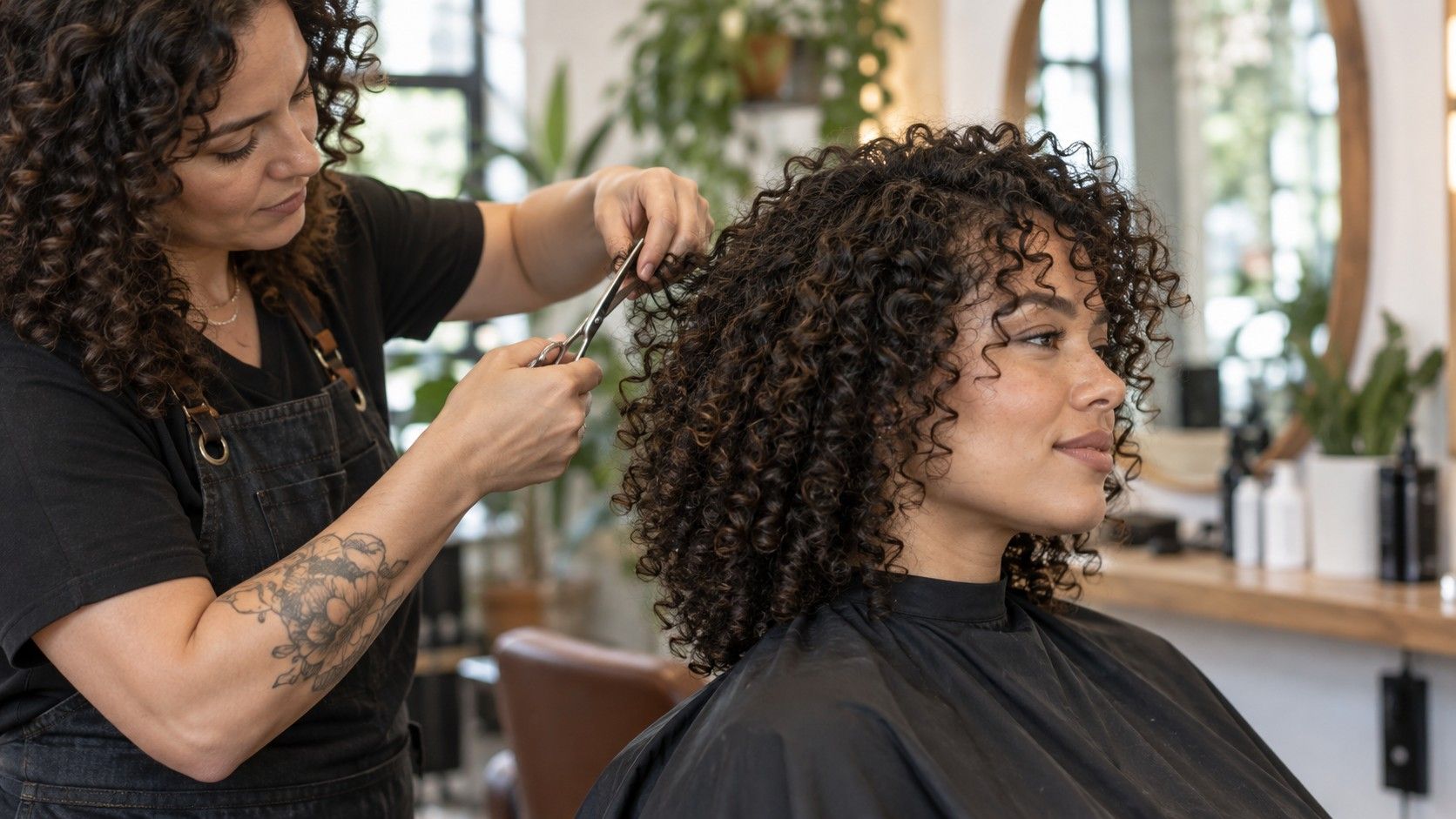
A curl-focused cut is usually built around the way groups of curls sit together, rather than around perfectly even wet lengths. Long layers can prevent a triangle silhouette when hair expands near the shoulders, but layers placed too high can create a shelf that is hard to blend. A rounded cut works well when curls have similar spring through the head; a more elongated outline often suits hair that is tighter around the face and looser underneath.
Ask where the shortest layer will live when dry. That question prevents the familiar surprise of a fringe that has become much shorter than intended. A dry cut can make this easier because the stylist sees the curl clumps at their real length, although it still helps to arrive with clean, detangled hair and minimal stretching. If your curl pattern varies, request a shape that follows the strongest areas instead of forcing every section into one identical length.
| Cut direction | Often useful when | Watch for |
|---|---|---|
| Soft long layers | Hair feels heavy at the ends and curls open easily | Very short top layers can make a bulky crown |
| Rounded bob | Medium-density curls need a deliberate outline | Dry length may sit above the jaw more than expected |
| One-length base with light shaping | Fine curls need stronger-looking ends | Too much internal removal can make the outline sparse |
Everyday curly hairstyles should not fight texture
For day-to-day wear, the most reliable curly hairstyles are usually variations on a good dry shape. Wear the hair down with the parting that forms naturally, pin one temple back, or gather only the top half with a soft tie. These options leave the curl pattern visible and do not demand that every coil match. A high, tight ponytail may look dramatic for an hour, but it can disturb the crown and pull on a sensitive hairline.
Try styling around the places that change first. If the front loses definition by afternoon, twist two face-framing sections while they are damp and let them dry before separating. If the nape tangles, use a looser low gather with a satin scrunchie rather than repeatedly brushing it out. A few well-placed pins under the upper layer can alter the silhouette without crushing the whole head. The goal is a style you can refresh with damp hands, not one that falls apart after a short walk outside.
How you dry curly hair affects the cut more than many people expect. Product applied to soaking-wet hair tends to encourage larger curl clumps and a more compact shape; applying it later can leave a fuller, less uniform result. Neither is automatically better. Choose according to whether you want separation at the roots, more length, or a smoother outline around the cheeks. Make one change at a time so you know which step moved the result.
A diffuser is helpful when used as a drying tool rather than a device for constantly rearranging the hair. Begin with low airflow, hover around the roots until the surface is less wet, then cup sections only if they hold their form. High heat and vigorous movement can scatter clumps, especially on porous hair that dries quickly at the ends. In humid weather, leave a little more hold in the routine and avoid touching curls until they are fully dry; early handling often creates the fuzz blamed on the weather.
Prepare clearly for a curl-focused appointment
Bring several photos of your own hair on good and difficult days, not only saved inspiration images. Point out which parts you like: a wider crown, a longer fringe, a visible jawline, or less bulk near the ears. Then say what has failed before, such as layers that flipped outward or thinning that left the ends weak. This gives the stylist usable information without pretending there is one correct curl category.
Agree on the dry length before the first major section is removed. It is reasonable to start conservatively, look at the outline after a few pieces, and take more only if the balance needs it. Tell the stylist how you normally part your hair, whether you diffuse, and how much daily styling you will honestly do. A cut that needs twenty careful minutes every morning is not low maintenance simply because it looked effortless in the chair. The right result is one that still looks intentional on an ordinary weekday.
It also helps to decide what you will do between cuts. Curly ends do not need a rescue trim every time one strand looks different, and chasing uniformity can gradually erase a shape that was working. Instead, note whether the perimeter is catching on clothing, whether one side has stopped forming its usual clumps, or whether the crown has become difficult to refresh. Those are useful signals for a small adjustment. A clear record of how the cut wore over several weeks gives you a better next conversation than a single flattering salon photo.