Long hair can make an updo look generous with very little effort, but it also exposes a weak foundation quickly. A bun that seems secure in the bathroom can slide by lunchtime, while a style that is pulled too tight may leave the scalp sore before dinner. The most useful easy updos for long hair rely on placement and grip, not on an endless supply of pins.
Choose the style for the day, not just the photo
Start by deciding what the style must survive. A desk day, a windy commute, a formal meal, and a workout-adjacent errand all ask different things of the same length. If you will lean against a chair, a very low knot can become uncomfortable; if you will wear a collar, a high bun may catch and loosen. For a long day, choose a style that can be adjusted in two minutes with one spare elastic and two pins.
Use a low bun or twist for work and travel
Freshly washed hair often feels too slippery for elaborate up hairstyles for long hair. Give it a little texture with a light mist of dry shampoo at the roots or by building the style on second-day hair. Do not rough up the full length just to make it hold. The strongest grip usually belongs near the base, where the elastic sits, while the visible sections can stay smooth and soft. That contrast looks more deliberate and is easier to undo later.
Make hair pins work instead of multiplying them
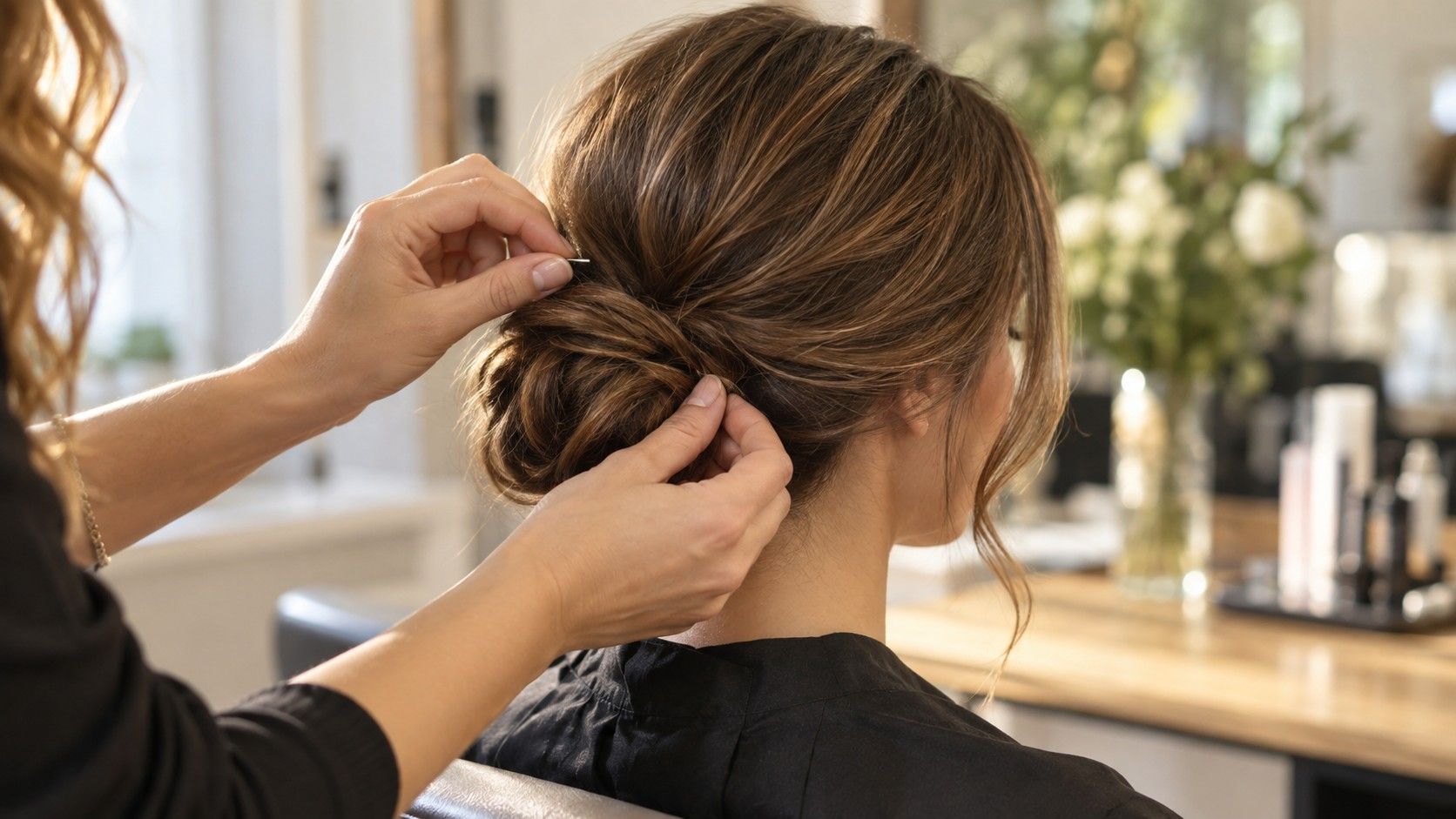
A low bun is one of the simplest ways to make long hair look finished without asking it to behave perfectly. Gather hair at the nape, secure a loose ponytail, twist the tail only once or twice, and coil it around the base. Insert pins from the outside of the bun toward the elastic, catching a small amount of scalp-side hair before turning the pin inward. This anchors the bun instead of merely decorating its surface.
A low French twist is useful when you want the neck clear but do not want a round bun pressing against a chair. Sweep the length to one side, fold it back over itself, then tuck the ends into the vertical seam. Keep the seam slightly off-center if your hair is very heavy; a perfectly centered twist can open under its own weight. Pull a few tiny face-framing pieces out only after the main structure is secure, otherwise they become an excuse to keep rebuilding the whole style.
| Style | Best use | Foundation |
|---|---|---|
| Low bun | Workday or dinner | Low elastic plus crossed pins |
| French twist | Collar-free outfit or warm day | Vertical seam held close to the head |
| Looped ponytail | Fast errand or travel | Elastic with the tail partly pulled through |
| Half-up knot | When full length should remain visible | Small top section and two discreet pins |
Build soft event styles on a secure hidden base
Soft does not need to mean loose everywhere. For a relaxed-looking event updo, make a stable ponytail first and hide it under the style. Split the tail into two or three sections, twist each gently, then pin the twists around the base with space between them. This creates dimension without relying on one large coil. If the hair is very long, folding each section in half before pinning prevents heavy ends from working free.
Volume around the crown is best added before the bun is formed. Lift a small section near the crown, support it with your fingers, and pin the base lightly rather than teasing it into a dense tangle. A center part can feel striking with a low knot, while a soft side part gives the front more movement. Check both sides in a mirror before leaving; long hair can make an asymmetry look intentional on one side and accidental on the other.
Most pin failures come from putting a pin through too much hair or from placing it parallel to the surface. Open the pin only enough to catch the section, slide it against the scalp, then rotate it so the closed end travels into the style. A pin that catches the elastic or the base of a twist has something solid to hold. A pin pushed into the middle of a glossy bun often slides straight back out.
Use two pins in an X only where the style truly needs reinforcement, such as under a heavy side section. Too many pins create pressure points and make removal frustrating. Match the pin finish closely to your hair so you can use fewer, more strategic pieces. If an elastic feels like it is doing all the work, replace it with one that has better grip rather than tightening it until the scalp feels strained. Security should come from structure, not discomfort.
Take the style down without creating breakage
Removal is part of the style. Find and remove the pins before pulling at the elastic, working from the outermost decorative pieces toward the base. Support the bun with one hand while easing out each pin; this prevents a trapped section from being yanked through a knot. If a pin will not move, trace its path slowly rather than tugging. It may have caught a twisted strand underneath, not simply become stuck.
Once the hair is down, separate the ponytail base with fingers before using a brush. A small amount of leave-in conditioner on the ends can help if the style was worn for many hours. Avoid sleeping in a tightly built updo, even if it still looks presentable, because tension shifts as you move and the elastic can press on the same area all night. The best simple updos leave you with hair that is still easy to wear the next day.
Keep a tiny repair kit where you actually use it: one elastic, four pins, and a small claw clip are usually enough. A loose section can be folded under a bun or clipped at the nape without taking everything apart. That matters more than an intricate technique when you are getting ready in a hurry. With a little practice, simple updos become a reliable way to move long hair out of the way while still looking considered, rather than a style reserved for the rare day when every strand cooperates.
Before relying on a new version, wear it around the house for half an hour. Turn your head, bend down, and check the back with a hand mirror. If the base shifts, add one pin at the elastic rather than tightening every section. This small test reveals whether the style is genuinely secure and lets you correct it while there is still time.